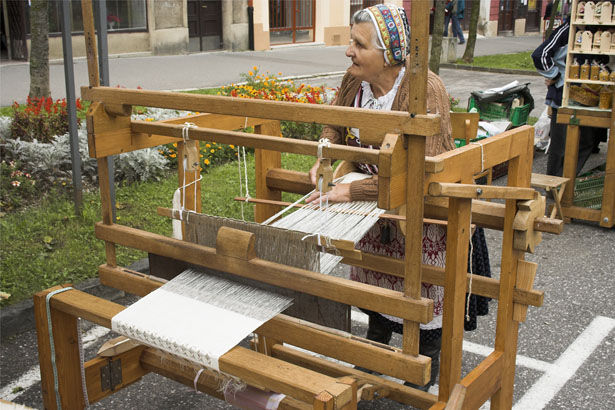
Linen production in the Czech lands was, for several centuries, one of the most economically significant rural industries. The Liberec and Jablonec districts of northern Bohemia built considerable wealth on hand-woven linen exported across Central Europe in the 17th and 18th centuries. Vysočina (the Bohemian-Moravian Highlands) and parts of east Bohemia around Hradec Králové and Trutnov also had established cottage-weaving traditions that persisted into the early 20th century.
Industrial spinning and mechanised weaving displaced most of the hand production by the 1880s, but a continuous thread of craft practice survived through folk museums, regional craft associations, and individual weavers who maintained traditional techniques for cultural and artistic reasons. Today, renewed interest in natural fibre crafts has brought linen work back into active Czech craft communities.
Flax Cultivation
The common flax (Linum usitatissimum) used for fibre requires a cool, moist climate and a well-drained, non-compacted soil. The Vysočina upland climate — cold winters, cool summers, and relatively high precipitation — is well suited to fibre flax production. Varieties grown for fibre are taller and less branched than oil-flax; Czech traditional agriculture documented varieties such as Mariánský and Kompolti, though modern commercial varieties have largely replaced these in agricultural use.
Flax for fibre is sown densely in April — at roughly 1,800 seeds per square metre — to encourage tall, unbranched growth. It is harvested by pulling (not cutting) in mid-summer when the lower third of the stem has turned yellow, which preserves the full fibre length down to the root. Cutting is faster but shortens accessible fibre by 10–15 cm.
Retting: Water and Dew Methods
Retting is the controlled rotting of the pectin that binds flax fibres to the woody stem core. Two traditional methods were used in Czech regions:
- Water retting: bundles of pulled flax are submerged in a slow-moving stream or pond for 10–14 days. Microbial activity breaks down the pectins efficiently, producing the finest, most lustrous fibre, but the process creates a significant odour and was traditionally done in designated stretches of river. Water-retted fibre from the Sázava and Chrudimka rivers was considered premium quality in 18th-century trade.
- Dew retting: bundles are spread on a grass meadow and left to absorb dew and light rain over 4–6 weeks, turned regularly. The process is slower and produces slightly coarser fibre but is less odorous and requires no water infrastructure. Dew-retted linen was more common in upland areas far from suitable streams.
Under-retting leaves pectin intact and makes the subsequent breaking and scutching more difficult. Over-retting weakens the fibres and increases loss during processing. Assessing readiness by feel — the fibres should separate easily from the stem without fraying — is a skill that takes a full season of practice to develop.
Scutching and Hackling
After retting and drying, the flax is broken — passed through a wooden flax brake that fractures the woody core — then scutched by beating with a flat wooden board against a vertical post to remove the brittle shives. The remaining fibre, called straw, is hackled through progressively finer metal-toothed combs to align the fibres and remove short tow fibres. What remains is a soft, aligned sliver of long-line flax ready for spinning.
The tow fibres removed during hackling are not wasted. They are spun into coarser yarn used for sacking, rope, and lower-grade cloth. In Czech cottage industry, tow was often assigned to apprentices and younger household members as practice material.
Hand Spinning
Long-line flax is spun using the wet method — the spinner's fingers are kept damp throughout to consolidate the fine fibres into a smooth, strong yarn. Czech distaff spindles (known as vřeteno) were typically turned from birch or pear wood, weighted at the bottom with a clay or wooden whorl to maintain steady rotation. The distaff itself — a forked stick or bundled reed — was mounted at the spinner's waist or inserted into a belt loop, keeping both hands free for drafting and guiding the fibre.
Spinning speed and consistency determine yarn quality. A fine, even yarn suitable for tablecloth weaving requires drafting the fibre slowly and maintaining steady tension throughout. Thick-and-thin irregularities in the spun single become prominent after weaving, particularly after wet finishing when the cloth contracts.
Natural Dyeing
Undyed natural linen ranges from off-white to pale tan depending on retting and drying conditions. Traditional Czech dyers used a limited palette of locally available plant dyes:
- Weld (Reseda luteola) — the most lightfast natural yellow, used to dye linen from at least the medieval period. The whole plant above ground is simmered and the yarn mordanted with alum.
- Woad (Isatis tinctoria) — historically grown in Bohemia and fermented into a vat dye for blue. It requires an alkaline reduction vat and experienced handling; the technique died out in most regions after indigo became available.
- Oak galls and iron — combined to produce durable grey-black shades without a separate mordant step. Still used by craft dyers for historically accurate reproduction work.
- Madder (Rubia tinctorum) — gives warm terracotta and red when used with alum mordant on protein fibres, but produces a more muted brick tone on linen cellulose. Mordanting with tannin before alum improves strike.
Hand Weaving on Traditional Looms
The floor loom used in Czech cottage weaving is typically a four-shaft counterbalance or countermarch loom with a wooden beater and fly shuttle added in the 19th century for faster cloth production. Traditional plain-weave linen (plátno) requires only two shafts, but decorative damask tablecloths and the complex twill patterns of north Bohemian weaving traditions require four or eight shafts and specific threading sequences.
Sett (threads per centimetre) for handspun, hand-woven linen varies widely. A utility cloth for sacking runs at 6–8 threads/cm in both warp and weft; fine tablecloth linen achieves 16–20 threads/cm and requires multiple passes at slow speed with a light beater.
Contemporary Czech Fiber Craft
Several organisations in the Czech Republic maintain documented information on traditional linen and fiber crafts. The ÚLUV registry includes practitioners of hand-weaving, natural dyeing, and flax processing. The Muzeum textilu in Česká Skalice — in the east Bohemian town historically known for its linen industry — holds a working collection of historical looms and documents regional weaving patterns.
Contemporary weavers often combine traditional linen with other plant fibres — nettle, hemp, and ramie — processed by similar retting and spinning methods. Hemp fiber crafts in particular have seen renewed interest following changes in agricultural policy that make hemp cultivation more accessible to small-scale growers.
References
- ÚLUV — Centre for Folk Art Production
- Staněk, J. (1959). Tkalcovství v Čechách. Nakladatelství Československé akademie věd.
- Muzeum textilu, Česká Skalice


